
- National /
- UNHCR urged to prioritize safe, dignified and voluntary Rohingya repatriation

Jahangir Alam and Mustafa Kamal Akand
Published:2026-06-10 17:25:40 BdST
Excluding local NGOs from JRP goes against the commitment to localizationUNHCR urged to prioritize safe, dignified and voluntary Rohingya repatriation
The Rohingya crisis is now in its ninth year. Since 2017, the Bangladesh government, local communities, national and international NGOs, and UN agencies have been providing critical humanitarian assistance to the approximately 1.2 million Rohingya refugees sheltering in Cox’s Bazar. A Joint Response Plan (JRP) is prepared annually to coordinate these efforts.
However, local stakeholders have expressed concern over the exclusion of local NGOs from this year’s JRP implementation framework. According to them, excluding local NGOs from the implementation of the JRP is inconsistent with the localization commitment made under the Grand Bargain, to which UNHCR is a signatory. UNHCR must prioritize partnerships with local NGOs.
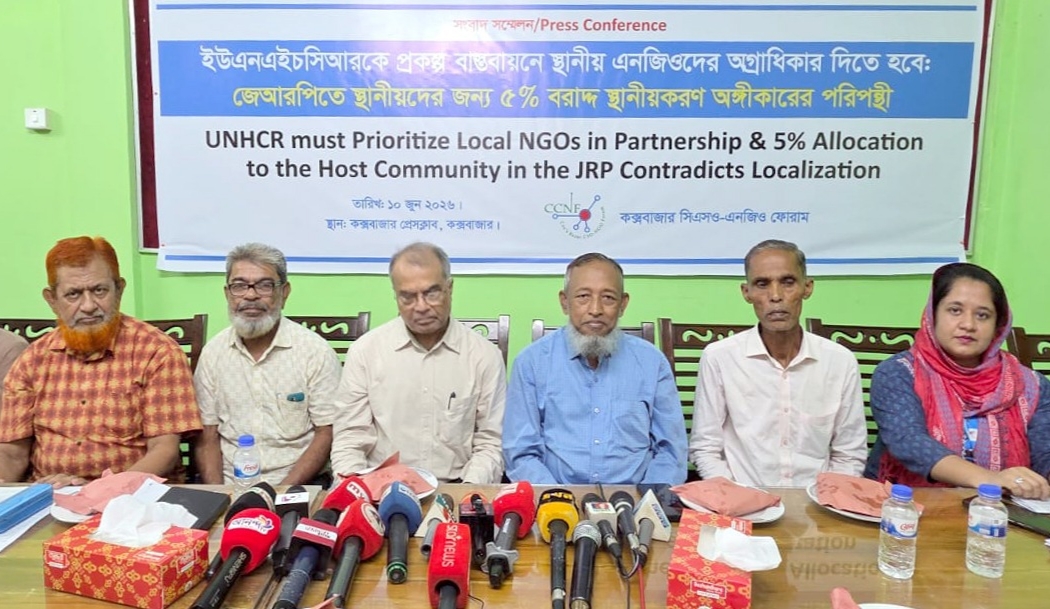
They said this at a press conference titled "5% allocation for host communities in JRP is not consistent with localization commitment" organized by the Cox's Bazar CSO NGO Forum (CCNF) at the Cox's Bazar Press Club today.
Speakers demands greater inclusion of local stakeholders in Rohingya humanitarian activities and ensuring their meaningful participation in the decision-making and implementation processes.
They also criticized the lack of opportunities for local NGO representatives at the JRP inauguration ceremony, saying that the proposal for a speech by a local NGO representative at the JRP inauguration ceremony was not accepted, while representation was ensured through international NGOs.
Speakers emphasized that the JRP must be more inclusive in light of the global localization commitment and ensure the meaningful participation of local and national organizations, as well as international NGOs and UN agencies. Speakers also proposed a “JRP 2.0” framework, which would include a clear roadmap for the safe, voluntary and dignified repatriation of Rohingyas to Myanmar.
Moderated by CCNF Chief Moderator Rezaul Karim Chowdhury; this press conference was addressed by Anjuman Ara of local NGO Prosbi, Md. Iqbal Uddin, Md. Shahinur Islam and Tahrim Afroz Tumpa of Coast Foundation; Newaz Md. Selim of Cox's Bazar Tourism Industry Cooperative Society Limited; Nurul Kabir of Rajapalong Union Parishad; Mozaffar Ahmed, former panel chairman of Palangkhali Union Parishad; Nurul Islam of Cox's Bazar Sahitya Academy; Nasima Akhtar of Cox's Bazar Youth Forum; Jahanara Islam of Cox's Bazar Women Chamber of Commerce and Momtaz Uddin Bahari of Cox's Bazar Press Club.
CCNF members and journalists from various print and electronic media of the country were also present at the press conference.
Rezaul Karim Chowdhury reiterated the demand for the safe, voluntary and dignified repatriation of the Rohingyas and called for working together for the peace, security and welfare of the Rohingyas staying in the camps.
He also called on the government and UN agencies to take initiatives to purify and supply water from the Naf River to reduce pressure on groundwater.
Anjuman Ara expressed concern that unlike previous years, the JRP 2026 was not shared with local NGOs. He called for the inclusion of local NGOs and local government representatives in the implementation of the JRP.
Md. Iqbal Uddin emphasized the need to formulate a clear roadmap-based "JRP 2.0" for the repatriation of Rohingya.
Md. Shahinur Islam said that UNOCHA has allocated 150 million US dollars from the US government for the Rohingya crisis. Of which 92 percent has been received by UN agencies and 8 percent has been received by international NGOs. This is against their localization commitment.
He said that local organizations should be included as JRP applicant organizations in the upcoming fund allocation. They should be given the opportunity to provide direct funding.
Taharima Afroz Tumpa questioned the practice of international representatives speaking on behalf of local stakeholders at the JRP inaugural event and highlighted the importance of local representation.
Nurul Kabir said that only 5 percent has been allocated for the local community in the JRP 2026. He demanded that this allocation be increased to 25 to 30 percent in light of government guidelines.
Muzaffar Ahmed highlighted the continued influx of Rohingyas into Cox's Bazar and its adverse impact on the livelihoods and economy of the local people, and Nurul Islam called for greater transparency in the spending of UN agencies.
Nasima Akhtar said, "One local NGO has received more than 30 projects, while many local organizations have not received any projects. This monopolistic and centralized funding system must be stopped. She called for ensuring fair and equitable funding opportunities for all local NGOs."
Unauthorized use or reproduction of The Finance Today content for commercial purposes is strictly prohibited.