05/06/2026

Ensuring Basic Human Rights & Employment Through Robust, Integrated Local Initiatives
Mustafa Kamal Akanda | Published: 2025-12-24 16:33:40
Government efforts to address climate-induced displacement remain short-term and fragmented, focusing mainly on post-disaster relief and temporary housing while neglecting livelihoods, employment, health, and education. To effectively tackle this crisis, it is essential to integrate climate displacement into national and local development plans and budgets, strengthen the institutional, technical, and financial capacity of local government institutions, expand community-based sustainable rehabilitation and livelihood-focused adaptation programs, launch initiatives to create local employment and ensure basic human rights, and construct sustainable coastal embankments to reduce future climate risks.
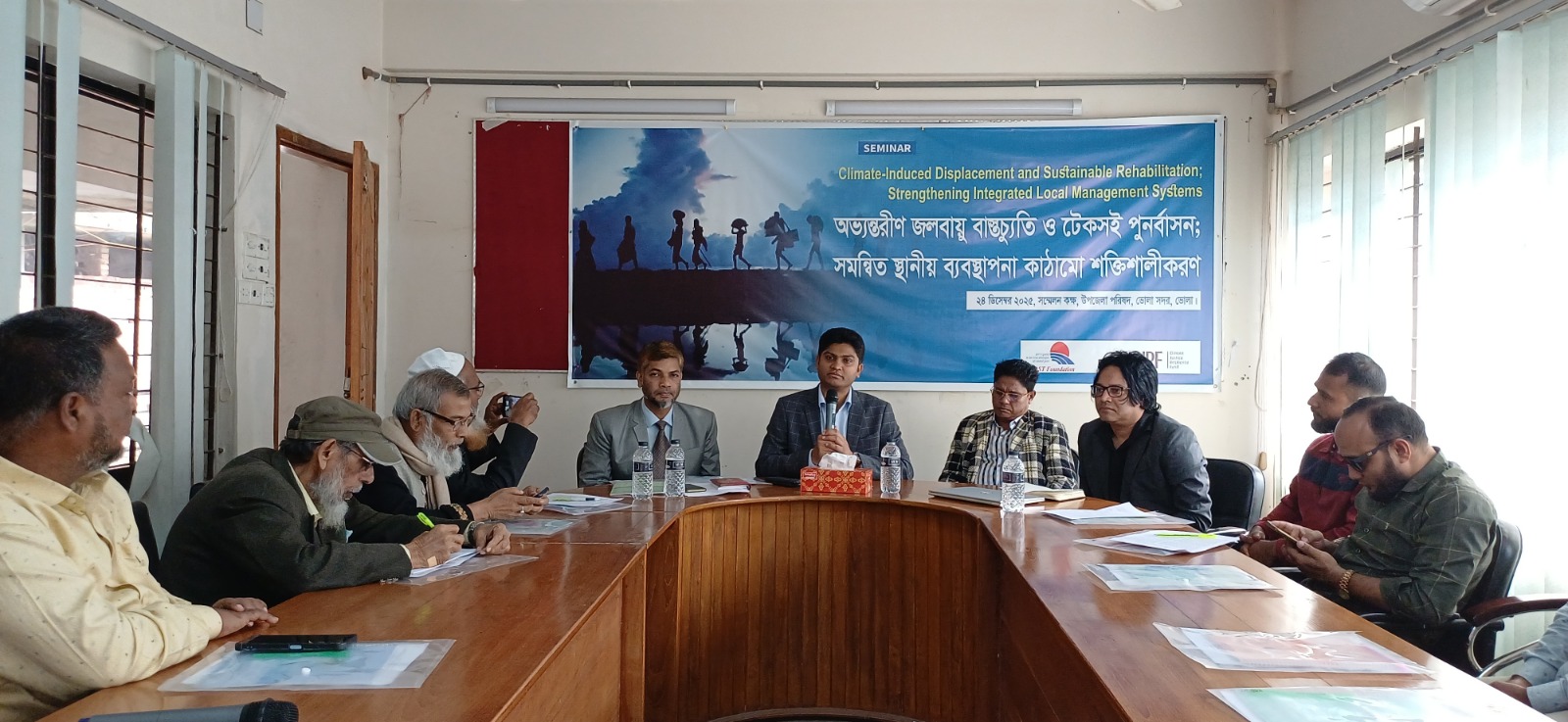
Speakers presented these demands at a seminar titled Challenges of Internal Climate Displacement and Sustainable Rehabilitation, organized by COAST Foundation on December 24, 2025, at the Bhola Sadar Upazila Parishad Conference Room.
The seminar was moderated by M.A. Hasan, Head of Climate Change of COAST Foundation, and chaired by Upazila Project Implementation Officer, Md. Ziaur Rahman. The chief guest was Upazila Nirbahi Officer, Md. Arifuzzaman.
Other distinguished guests included senior journalist of the Bhola Press Club, Mokammel Haque Milon, and Neamat Ullah, district representative of Daily Prothom Alo. Representatives from civil society, NGOs, journalists, and displaced communities also participated, sharing their insights and perspectives.
In his keynote speech, M.A. Hassan of COAST Foundation warned that emergency aid or isolated resettlement is not enough to address climate displacement. Strengthening local management is crucial to protect the dignity of displaced people, ensure sustainable resettlement, and build resilience against future climate risks. Local governments are closest to communities but often lack the resources and expertise needed for long-term solutions.
Upazila Nirbahi Officer Md. Arifuzzaman warned, severe River erosion is displacing people, leaving them helpless and stripped of everything. We cannot fight naturewe must adapt. Meanwhile, the developed world pollutes the environment yet advises us to protect it. Urgent action is needed to ensure clean water and create local income opportunities.
Upazila Project Implementation Officer, Md. Ziaur Rahman said, fully resettling displaced people on government khas land remains a major challenge, as most of these lands lie along riverbanks and in char areas. If safer plots on the mainland were available, displaced families would prefer to live there. Meanwhile, our sluice gates are failing, water drainage is being disrupted, canals are silting up, and embankments are gradually losing height.
Upazila Administrative Officer Tariqul Islam said, we are at high risk of river erosion due to geographical reasons. We need to build sustainable dams, create local employment through the efficient use of local resources, and educate the local youth in technical education.
Prothom Alo District Representative Neamat Ullah criticized the governments housing projects, saying, These homes are being built in areas cut off from basic communication, with no employment and no electricity. Resources are going to waste. Multi-storey buildings would save space and serve people better
Journalist Md. Mokammel Haque Milon said, many housing projects in Bhola have failed to meet expectations due to poor site selection and allocations made without consulting the community. Genuine public consultation is essential before any rehabilitation programs or new projects for climate-displaced people.
Journalist Harun Or Rashid Shimul said, People do not live in shelter projects because they do not have the minimum living conditions.
Md. Abbas, a displaced resident of Char chatkimara, said,Our island is cut off from Bhola Sadar during bad weather. Without an embankment, we live in constant fear of disasters. Our children have no access to secondary education, and there are no health services.
Asma Begum added, I worry my house along the Tentulia River in Beduria Union wont survive the next monsoon. A sustainable embankment is urgently needed.
Arshad Mazi from Dhonia Union said, many families have already migrated to Dhaka or Chittagong in search of better livelihoods.
Editor & Publisher : Md. Motiur Rahman
Pritam-Zaman Tower, Level 03, Suite No: 401/A, 37/2 Bir Protik Gazi Dastagir Road, Purana Palton, Dhaka-1000
Cell : (+88) 01706 666 716, (+88) 01711 145 898, Phone: +88 02-41051180-81